
1659 to the present day
The evolution of animation, in the order it happened
Animation was not invented in a studio in 1928. It was built over three centuries, by scientists, toymakers, cartoonists, puppet makers, broadcasters and computer researchers who mostly never met. This is the whole line, in order, with the evidence attached.
Four ways in
Start wherever the question starts
The same records, reached four different ways. Nothing is locked behind a particular route.
The interactive timeline
Every documented event on one line, filtered by period, country, technique or production type, or searched by keyword.
Open the timeline 02 · By periodDecade by decade
Each period introduced by an essay on what actually changed, followed by the events that belong to it.
Browse the decades 03 · By traditionTopic histories
Drawn, dimensional, broadcast, Japanese and computer animation, each followed from beginning to present.
Read the histories 04 · By termGlossary
What a bar sheet is, why animating on twos matters, and the difference between a key and an in-between.
Look something upEight turning points
The moments the medium changed direction
Eighteen events in this record are examined at length. These eight are the ones that reorganised everything after them.
Reynaud projects Pantomimes Lumineuses at the Musée Grévin
Reynaud projected long hand-painted picture bands to a paying Paris audience, presenting short comic stories with music and live sound effects — the first public exhibition of projected animation.
Read the full record 02 · 1914Gertie the Dinosaur performs on stage in Chicago
McCay appeared on stage beside a projected dinosaur, issuing commands she obeyed, ignored or resented, and finishing by apparently stepping into the screen to ride away on her back.
Read the full record 03 · 1928Steamboat Willie premieres with synchronized sound
A seven-minute short in which action, music and effects are locked together frame by frame opened at the Colony Theatre in New York and made synchronized sound cartoons a commercial certainty.
Read the full record 04 · 1937Snow White and the Seven Dwarfs opens in Los Angeles
The first American cel-animated feature premiered at the Carthay Circle Theatre after three years of production, combining multiplane depth, rotoscoped reference and sustained dramatic acting.
Read the full record 05 · 1963Astro Boy launches weekly television anime
A weekly half-hour series adapted from Tezuka's comic established a production system capable of delivering serialized animated drama on a broadcast schedule and a very small budget.
Read the full record 06 · 1986Luxo Jr. gives a computer-animated object a personality
Two desk lamps, distinguished only by size and movement, play with a ball in a two-minute film that establishes character, relationship and emotional register without faces or dialogue.
Read the full record 07 · 1995Toy Story, the first fully computer-animated feature
Every frame of an eighty-one-minute feature was generated by computer, with a story built deliberately around plastic toys because rigid, manufactured surfaces were what the technology could render convincingly.
Read the full record 08 · 2018Into the Spider-Verse rebuilds the look of computer animation
Hand-drawn line work over three-dimensional characters, printing artifacts such as halftone dots and misregistered color, deliberate chromatic aberration and characters animated on twos produced a feature that looked like a printed comic in motion.
Read the full recordHow this is made
Sourced, checked, and open to correction
A historical record is only worth as much as its evidence. Every entry here carries at least two independent citations, and every claim of significance is presented as a judgment rather than as a fact.
- Institutional documentation is preferred: national libraries, film archives, museums, universities and edited reference works.
- Disputed dates are reported as disputed. Where historians disagree, the entry says so instead of picking the convenient version.
- Claims of the form “the first” are qualified, because they almost always depend on an unstated definition.
- Substantive corrections are logged in public and are never made silently.
About the illustrations
Every picture here was drawn for this project
There are no film frames, character images or posters anywhere on this site. Reproducing them would require permissions this project does not hold, and a historical record has no business borrowing what it cannot credit.
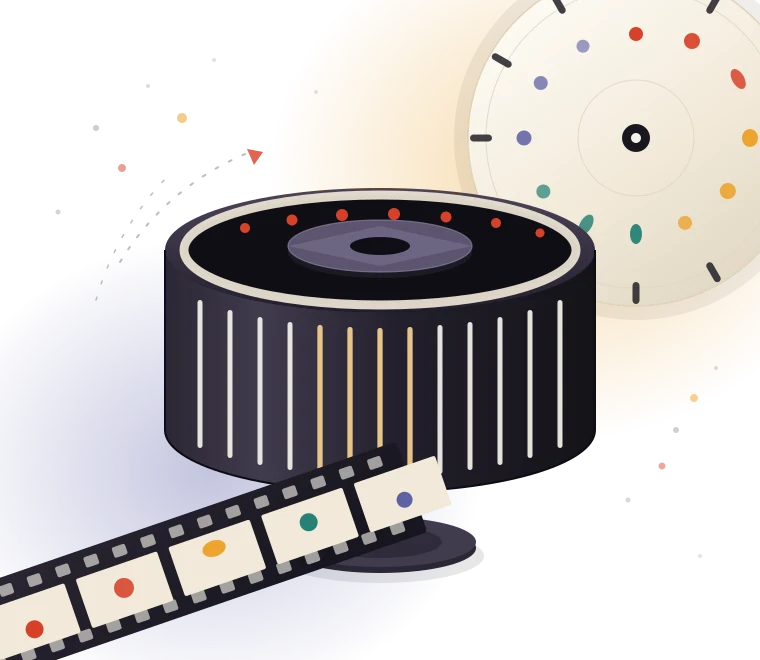
Instead, the illustrations depict apparatus and method: viewing drums and slotted discs, layered artwork on registration pegs, puppet armatures on a lit stage, exposure sheets, geometry becoming a shaded surface. They are original work, and they are there to explain something.