Japanese animation is often described as a style. It is more accurate to call it a set of solutions. Almost every characteristic that international audiences recognize began as an answer to a production problem, and was then developed into an expressive language of its own.
Before television
Animation was made in Japan from the 1910s onward, largely by individuals and small workshops, and much of that early work is lost. The first feature was completed in the closing months of the Second World War under navy commission and severe material shortage, and was seen by very few people at the time.
Its importance is indirect but real. Several founding figures of the postwar industry have described seeing it as the moment they understood that feature animation could be made domestically. A print rediscovered decades later confirmed a starting point the industry had been working from largely by memory.
Building an industry for export
A major film company established a dedicated animation studio in 1956 with a stated ambition to produce color features for international release. Its first, in 1958, adapted a Chinese legend and was distributed abroad, including in the United States.
That studio became the training ground for most of the following generation. Directors and animators who would define Japanese animation for the next fifty years learned the work there, and several left to found the independent production houses that made the medium's most ambitious films.
1963 and the weekly half-hour
Television changed everything. A weekly series adapted from a comic strip in 1963 had to deliver twenty-five minutes of animation every seven days at a license fee widely regarded as below cost, with merchandising expected to cover the shortfall.
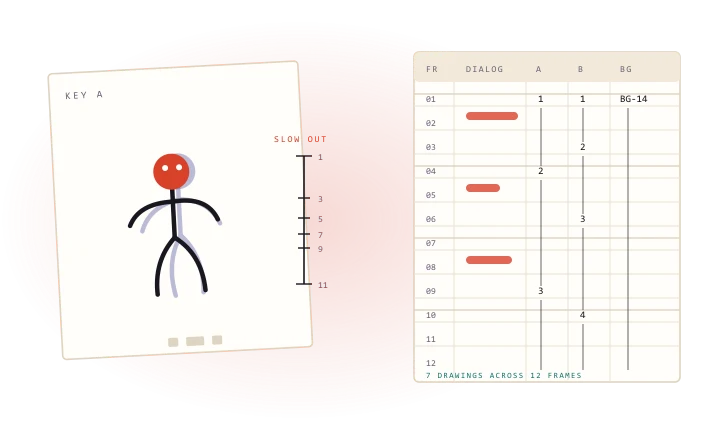
The production reduced its drawing count to roughly three per second, reused cycles and stock cuts extensively, and designed characters so that only a mouth moved during dialogue. It then discovered that these constraints could be used deliberately: a held drawing with a camera move carries more tension than fluid motion, and a sudden cut to a static close-up is a dramatic tool.
The language of the held frame
The visual conventions that international audiences identify with anime mostly originate here. Speed lines and radiating backgrounds replace drawn motion. Smear frames stand in for the movement between two poses. Long pauses rest on a still face while the score and the voice carry the scene. Expressive symbols appear on characters to state emotion directly rather than depict it.
The exposure sheet is where these decisions are recorded, and reading one is the fastest way to understand the discipline: seven drawings can cover twelve frames, and which seven is a creative judgment rather than a mechanical one.
Growing up
Through the 1970s, television animation in Japan stopped being children's programming. A 1974 science-fiction series with a season-long countdown found its audience through repeats and a theatrical compilation. A 1979 series about giant machines treated them as mass-produced military equipment inside a political conflict with casualties on both sides.
These productions created an older audience that identified with the medium, and a franchise economy in which model kits, compilations and continuity supported ambitious storytelling.
The features of the 1980s
A studio founded in 1985 by three collaborators who had worked together since the 1960s set out to make director-led features outside the television system. In 1988 it released a wartime tragedy about children starving and a gentle rural fantasy on the same program, which is as clear a statement of range as the medium has produced.
The same year brought a science-fiction feature of exceptional technical density, financed well above television norms and animated with a drawing count that showed. Its overseas release through home video and specialist distribution changed what international audiences expected of animation more than any other single title.
Recognition and its terms
A hand-drawn feature about a girl working in a bathhouse for spirits became the highest-grossing film in Japanese history in 2001 and won the Academy Award for Best Animated Feature in 2003, in the same period the American industry was concluding that hand-drawn features had no future.
Recognition has continued, most recently for another largely hand-drawn feature in 2024. It has not resolved the industry's structural problems. The low license fees established sixty years ago, long hours, extensive subcontracting and the precarity of freelance animation work remain the subject of sustained public criticism inside Japan and abroad.