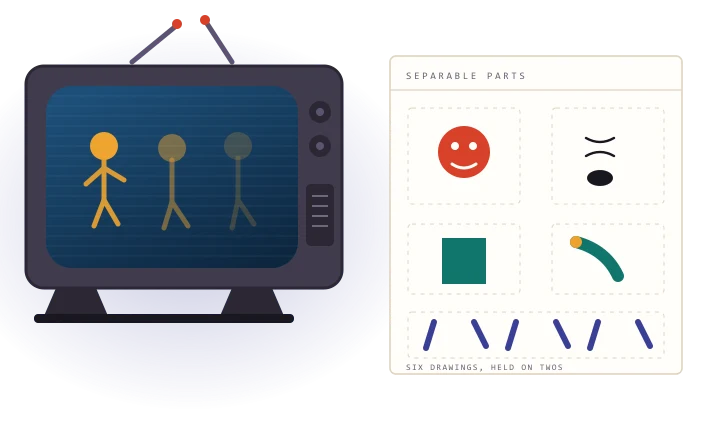
Television did not want what theatrical animation was selling. It wanted a great deal more of it, far more often, for a fraction of the money. The methods the industry invented to meet those terms have been criticized for seventy years, and they are the reason animation remained a mass-audience form at all.
The arithmetic
A theatrical short of the 1940s ran about seven minutes and might use ten thousand drawings. A television half-hour needs roughly three times that duration, every week, on a budget per minute that can be a tenth as large. No amount of efficiency closes that gap. Something has to be given up.
What the industry gave up was drawings. The core insight of television animation is that a scene can be carried by voice, staging and design while the picture itself changes as little as possible, and that an audience will accept this readily if the writing is good.
A vocabulary of reuse
The techniques are specific and systematic. Characters are designed so that a head, a mouth, an arm or a pair of legs can be drawn on a separate layer and swapped independently. Walk and run cycles are drawn once and reused for years. Backgrounds are built as long horizontal panels for repeating pans. Standard poses and expressions are cataloged so that a scene can be assembled rather than animated.
This is where the argument starts. Critics have called it a degradation of the craft since the 1950s. It is also a genuine discipline: deciding which four frames in a scene are worth drawing requires more analysis than drawing all twenty-four.
The graphic defense
The aesthetic case for simplification was made before television needed it. A studio founded by artists who had left a major animation house in the 1940s produced shorts built on flat color, open space and movement reduced to essentials, and won the industry's highest awards doing so.
That work mattered enormously to television, because it meant broadcast animation could be economical without conceding that it was inferior. The look of an entire era of children's programming, advertising and title design descends from it.
Prime time, twice
In 1960 an animated domestic sitcom entered American evening prime time with a laugh track and adult sponsors, and ran six seasons. It proved animation could hold an adult audience in the most valuable part of the schedule, and it established the half-hour animated series as a permanent category.
Pressure from advocacy groups and shifting network strategy pushed animation out of prime time by the late 1960s, and it spent two decades concentrated in weekend morning children's programming, a format defined by tight budgets, content standards and merchandising obligations. Prime time reopened in 1989, and the series that reopened it is still running.
A parallel industry in Japan
Japanese television animation began in 1963 under even harsher economics and reached the opposite conclusion about content. Rather than simplifying its stories to match its budgets, it simplified its drawing and told serialized drama with continuity, consequence and moral ambiguity.
By the late 1970s that approach had produced series about war in which the machines were mass-produced equipment and characters died, and had cultivated an audience that did not age out of the medium. The economics remained difficult, and low license fees established in the 1960s continue to affect animator pay.
Cable, creators and control
The launch of animation-only cable channels in the early 1990s broke the network gatekeeping that had confined American animation to weekend mornings. More importantly, these channels commissioned series directly from individual creators, often developing them from a single short film.
The results were markedly more distinctive than the licensing-led programming they replaced. Creator-led development is now the standard model for original animated television, and the most durable series of the last thirty years have come out of it.
Streaming and its instability
Subscription services began commissioning original animation directly from around 2017, funding adult series, international acquisitions and features that theatrical economics would not support. Production capacity expanded worldwide and audiences gained immediate access to work that had previously depended on imports and festivals.
The trade is volatility. Commissioning decisions can reverse quickly, completed work has been withdrawn from circulation for accounting reasons, and the long-term availability of animated programs now depends on platform strategy rather than on broadcast or physical distribution. Preservation has become a live concern rather than an archival one.