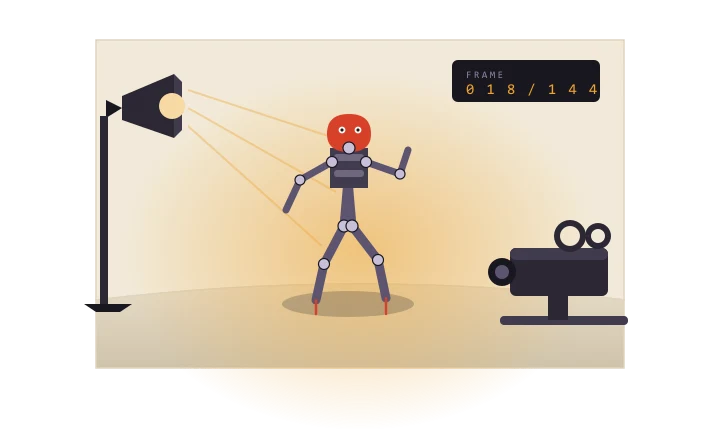
Stop motion is the only major animation technique that has never been superseded. It was among the first things filmmakers discovered they could do with a camera, and it is still being used to make award-winning features. What has changed is everything around it.
A discovery, not an invention
Once a camera could be stopped and restarted, filmmakers noticed that anything altered between exposures appeared to move by itself. The technique emerged around 1900 out of the trick film, in the hands of people who had trained as stage magicians and understood immediately that the shutter was the best illusion they had been given.
By 1907 an American short in which cutlery and furniture animated themselves in a hotel room was circulating in Europe and mystifying professional filmmakers, several of whom reportedly tried to reverse-engineer the method. Object animation spread across the continent within a couple of years.
Puppets that act
The decisive step was made in Moscow in 1912 by a museum entomologist who had failed to film live beetles and built articulated insect puppets instead. His films are not demonstrations; they are dramas, with staging, cutting, and characters whose behavior carries the story.
This established the essential proposition of puppet animation. A physical object, moved by hand a fraction at a time, can hold a performance. Everything that follows in the technique is an argument about how to build the object and how to move it.
The creature in the live-action frame
Through the 1920s and 1930s, model animation became Hollywood's method for putting impossible creatures on screen. Jointed metal armatures with sponge rubber musculature were animated frame by frame and combined with photographed actors through rear projection, miniature projection screens built into sets, and glass paintings.
The 1933 production that made this famous succeeded not because audiences were fooled but because they cared. The animation gives its creature small, unproductive movements, hesitations and moments of distraction, and those details are what read as a mind at work.
National schools
Elsewhere, stop motion developed as an art rather than as an effect. A Soviet feature in 1935 fielded hundreds of puppets with interchangeable heads for crowd work. Czech puppet animation, drawing on a long-established national theater tradition, produced feature-length work from carved wooden figures whose faces did not move at all, relying on lighting, posture and camera to carry emotion.
A publicly funded Canadian producer supported a different strand entirely: photographing live human performers one frame at a time, a technique known as pixilation, which gives bodies the impossible physics of animated objects. The 1952 film that demonstrated it won an Academy Award in a documentary category.
Broadcast scale
Television gave stop motion two things: a schedule it had never had to meet, and an audience of millions. Clay figures for a children's series in the mid-1950s proved the technique could be produced weekly, and hour-long puppet-animated holiday specials from 1964 onward, produced in Japan for American networks, became annually repeated cultural fixtures.
These productions also introduced the offshore co-production arrangements that would later become standard across the whole of television animation.
Digital tools, handmade result
The technique's revival from the 1990s onward is a story about everything except the animation. Frame-grabbing software let animators compare their current frame against the previous one in real time. Motion control allowed the camera to move in precise, repeatable increments. Digital compositing removed the support rigs that had always constrained what a puppet could do.
Then came additive manufacturing. Printing thousands of subtly different replacement faces gave puppets a range of expression comparable to computer animation, revisiting a replacement principle that dates back to the 1930s with tools that did not exist until the 2000s.
Why it survives
Stop motion is slower and more expensive per second than any competing technique, and it has repeatedly been declared obsolete. It keeps winning major awards anyway, including the Academy Award for Best Animated Feature in 2023 for a puppet film financed by a subscription service.
The reason is material. A stop-motion image is a photograph of a real object with real surfaces under real light, and the small irregularities that come from human hands touching things are exactly what makes the result feel present. Every technique that has tried to replace it has eventually tried to imitate it.