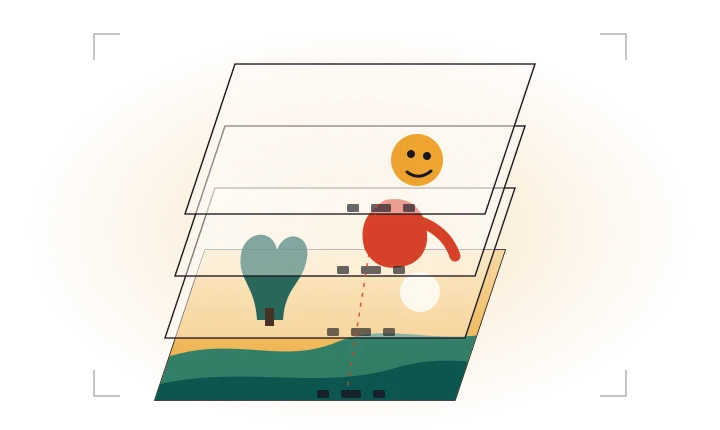
For most of the twentieth century, animation meant a drawing on a transparent sheet, laid over a painted background, photographed once and then replaced. This is the story of how that method was invented, industrialized, refined to an extraordinary level of craft, and finally dissolved into software.
Drawing on paper, one sheet at a time
The earliest animated films were made the hard way. Every element of every frame was drawn afresh, which meant that a character walking across a room required the room to be drawn again for each of the sixteen images that made up a second of screen time. Backgrounds shimmered because no two versions of them were identical, and detail was avoided because detail multiplied the labour without limit.
Working this way, a newspaper cartoonist produced four thousand hand-coloured sheets for a single short in 1911 and around ten thousand for a dinosaur that could act three years later. These are astonishing objects, and the method they used was completely unsustainable for an industry that needed to deliver a new reel every week.
The cel and the peg bar
The solution arrived in 1914 and 1915 in the form of two complementary patents: drawing the moving figure on a transparent celluloid sheet laid over a fixed painted background, and holding every sheet in exact alignment with a bar of pegs engaging punched holes. Together they separated what changes from what does not.
The economic effect is difficult to overstate. Backgrounds could now be painted once, in as much detail as an artist could manage, and reused for hundreds of frames. Elaborate settings became cheaper than plain ones. And because only the moving parts required drawing, an animator's time went into performance rather than into copying scenery.
The production line
Studios reorganised themselves around the new method almost immediately. Work divided into specialisms: story, layout, background painting, animation of key poses, in-betweening of the drawings between them, inking the lines onto the front of the cel, painting the color onto the back, and photographing the assembled stack under a rostrum camera.
This structure, established before 1920, remained recognisable in every hand-drawn studio for the next seventy years. It made large-scale output possible and it also created a rigid hierarchy in which most of the workforce, particularly the ink and paint departments, performed skilled work with little credit and less pay.
Learning to act
Technique alone does not produce performance. Through the 1930s, in preparation for feature-length work, studios began teaching drawing, anatomy and animal locomotion to their staff, and analysing live-action reference footage frame by frame. Out of that period came a body of practical theory covering anticipation, follow-through, overlapping action, arcs, weight, squash and stretch, and timing.
These ideas were never a formula, and the best work of the period argues against reading them as one. But they gave the medium a shared vocabulary for discussing why a movement feels alive, and they remain the basis of animation teaching worldwide, including in techniques that involve no drawing at all.
Depth, color and the widescreen frame
Cel animation is flat by construction, and much of the technical history of the 1930s and 1950s consists of attempts to defeat that flatness. The multiplane camera, a vertical rig holding painted glass layers at measured distances from the lens, produced genuine parallax as the camera moved. Three-strip color arrived in animation before it reached general live-action production, and was treated from the start as a dramatic instrument rather than as decoration.
Widescreen exhibition in the 1950s forced another rethink. A frame more than twice as wide as it was tall rewarded horizontal staging, longer held shots and fewer cuts, and animated features adapted their layout conventions accordingly.
The photocopier and the visible line
In 1961 a modified photocopying process replaced hand inking, transferring the animator's own pencil drawings directly onto the cel. It was adopted to cut cost, and it had an unintended aesthetic consequence: for the first time, audiences saw the animator's line rather than a traced ink outline, with all its roughness and variation.
That scratchy, visible line defined a whole era of feature animation. It also legitimised the idea that the mark of the hand could be a stylistic asset rather than an error to be cleaned away, an argument that returned in digital form four decades later.
Digital ink, and the end of the physical cel
By 1990 a feature could be produced without a single celluloid sheet. Pencil drawings were scanned, colored on screen, composited in software and output to film. The physical limits of the cel disappeared with it: layer counts were no longer capped by the yellowing and dimming of stacked plastic, and camera moves became possible that no rostrum rig could execute.
Audiences experienced the resulting films as traditional animation, and in every sense that matters they were. The drawings were still drawn. What changed was everything downstream of the drawing.
Closure, survival and return
In 2004, after a run of commercial disappointments, the major American studios closed their hand-drawn feature units and moved entirely to computer animation. The reasoning attributed the box-office gap to technique rather than to material, a reading many artists and historians dispute.
Drawn animation did not end. It continued in Japan, sustained European feature production through co-financing and public funding, remained the default in television, and returned to American screens through rendering research that reintroduced the drawn line into three-dimensional production. Traditional animation is now one available technique among several, which is a considerably healthier position than being the only one.